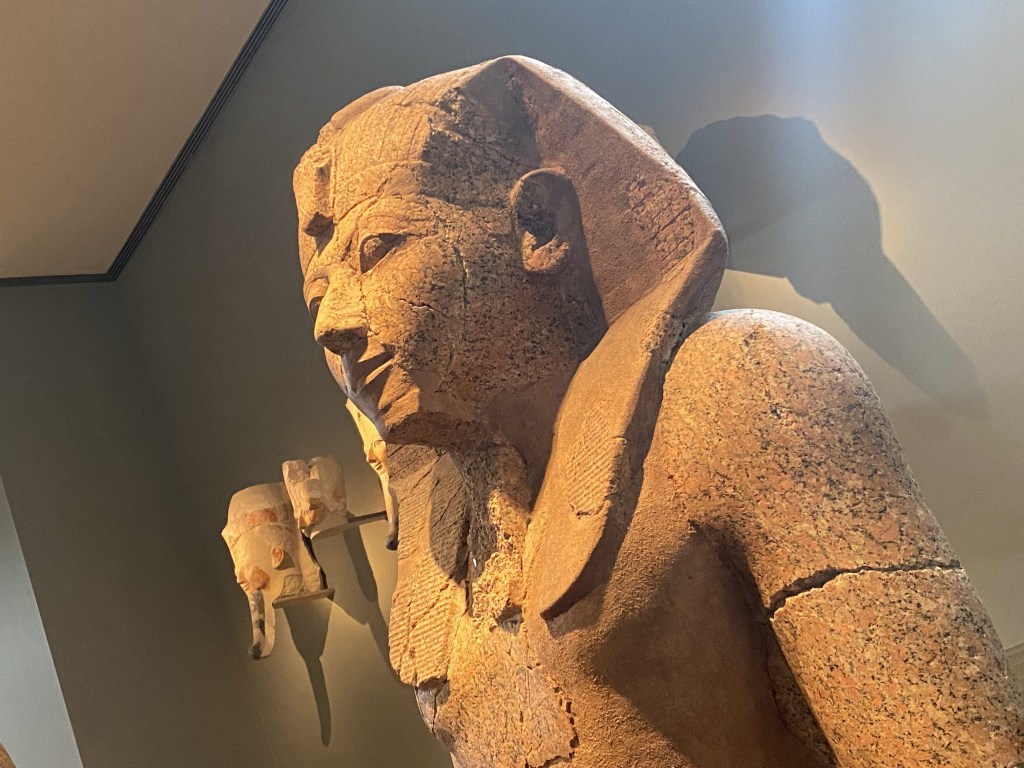
Many, many groups of schoolchildren are weaving their way through the dimly lit galleries of ancient Egypt. I tag along behind one as they squeeze their way into the narrow spaces in the Mastaba Tomb of Perneb, phones aloft, filming over their own four-foot tall heads as they meander through, ducks in a line. They suddenly about face. I move to the side as one girl, nonplussed, says, “I just wanna see a corpse.” Many corpses, at least mummified ones can be found in the ancient Egypt exhibits. A preoccupation with death and especially with the afterlife is all around.
There is nothing new under the sun, is there? While my evangelical relatives will say, “death is the enemy,” it seems the ancient Egyptians would say, “death is just another phase of life.” You leave here and go someplace else, so you need lots of art to guide you along the way. Such as these model boats. They were found in 1920 in an area that appeared to have been thoroughly looted, but wasn’t. They look like model boats in the usual sense that they were meant to be replicated as an actual boat, but no. These were decorative and representative of one’s journey to the afterlife and of ensuring bountiful provisions once one arrived there. For whatever reason this reminded me of the biblical idea of streets paved with gold in heaven (Revelation 21). It is such an odd thing to look forward to. Fantasies of gold and jewels as a heavenly reward seems to contrast with Jesus’s command to give away all of one’s possessions. Or are we meant to do that only because there is gold later? It perplexes me.
I guess because life is really so wonderful, humans throughout time have created narratives to try to make sense of it ending. As a person well into the second half of my life, I get it. And as an American, my goodness, we do not like to talk about it. I appreciate how the ancient Egyptians (and many other cultures today) celebrate death as just another part of life. I would like to talk about it more.
The Egyptians celebrated birth and fertility as one a way to acknowledge death and offer a hopeful counterpart: life goes on. I fell in love with this hippopotamus fertility goddess. She is so cute; I can’t get enough of that beatific smile. I would totally trust her with my unborn children. My dad and his wife had a replica of William the hippopotamus, the more famous Met mascot in their home when I was growing up. I remember it fondly.
And birds! Birds everywhere. It makes sense given the abundance of bird life in the Nile’s marshes. The carvings depict them so precisely, that modern designations of species are obvious. My beloved falcons were in abundance, as well, soaring over kingdoms in protection.
My last stop was yet another same-song-second-verse, learning about the badass female pharaoh, Hatshepsut. Hatshepsut does all the work (famously commissioning key battles and championing the arts) and Thutmose III takes all the credit. I wonder what advice Hatsepsut would give to Shiv Roy? Succession is nothing new, and neither is misogyny. The Smithsonian has a piece about her if you are as intrigued as I was.
I’ll end today with a word about the guards. (Patrick Bingley’s book about them is very sweet, by the way.) First of all, the Met is a labyrinth. It is the Winchester Mystery House of museums. All I wanted to do was find the damn elevator to the Rooftop Garden and get some air. The museum was getting really crowded and I needed some air. Apparently they are only allowed one sentence, or really, one phrase, of instruction. I asked three different guards.
Their responses:
“Go through Medieval.”
“Straight past Medusa’s head.”
“Through the black then right.”
I managed to find it. It is very nice up there.
It was time for me to head out. But how? Like a casino, you can get into the Met, but getting out? I asked a final guard.
“That way.”
 The Met Project