As with the Egyptians, the Greeks also bump into the Romans when the timeline crosses into the common era. Also, as with the Egyptians, much of the art, at least in the thousands of years covered in the Met, is associated with funeral rites. On my way through a dozen galleries leading to the classical Greek statuary, I looked at approximately 9 million amphoras; I mean, honestly, that doesn’t feel exaggerated. They are mostly a version of Attic vase painting, both red and black figured. These depict elaborate scenes of battle, funerals, and the lovely mundane (a woman feeding geese); since most ancient Greeks were illiterate, much of our knowledge of their daily life comes from these painted amphoras. They were not only used for funerals, however. Some had practical uses: carrying water or mixing wine with water. (Apparently, it was considered barbaric to drink undiluted wine.) Wine consumption was a large part of the symposium, so many amphoras were needed for those events. These are all stunning, but my favorite is a small stirrup jar decorated with an octopus.
The Greek funeral monuments look so much like ours (ours imitating theirs, that is), that it took me a few minutes to wrap my brain around the fact that they are of a similar time frame as the Egyptian tombs and mummies. Those seem so old. The Greek ones seem…familiar. They anointed the body with oil, dressed it, and placed it on a high bed, a process called the prothesis. People would come to mourn, basically a wake. Rather than placing many items in the coffin like the Egyptians, they kept it simple with statuary and engraved elegiac poems. Their immortality lay in the memory of their lives by others.
Regardless of the simplicity of their rites, the ancient Greeks had a similar view of the underworld as the Egyptians: after death, your animate spirit, your psyche, left your body like a puff of air. You then traveled to the underworld and completed tasks to get yourself out of there. Their view of the gods was transactional – you did something for the gods, and the gods did something for you. Their gods were human-like and inspired much literature and art — Homer’s The Odyssey for one, and gorgeous statues like this one of Dionysos. When the Romans conquered, they took on the same pantheon but renamed them. Their view of the gods was more practical – they merely existed, like everything and everyone else, to ensure the safety and prosperity of the state.
Side note about the Dionysos statue: a gaggle of teenagers on a school trip came into the gallery, two girls struck the same pose as the statue, under the statue, then instantly posted it to Instagram. In a matter of 20 seconds. Possible captions: winegod + kid or whyyousobigandmesosmall or I’m a statue. I’ll never know. Whatever it is they thought it up fast.
No one was taking photos with the Egyptian mummies or tombs but there were so many photos happening in these galleries. A woman took a snap of her husband standing next to a statue while simultaneously attempting to entertain her preschooler: “Look! The man is riding a dolphin on that one! No, don’t touch that! Stop running! Come look at the dolphins, honey!” The dolphins are very cute. He should have looked.
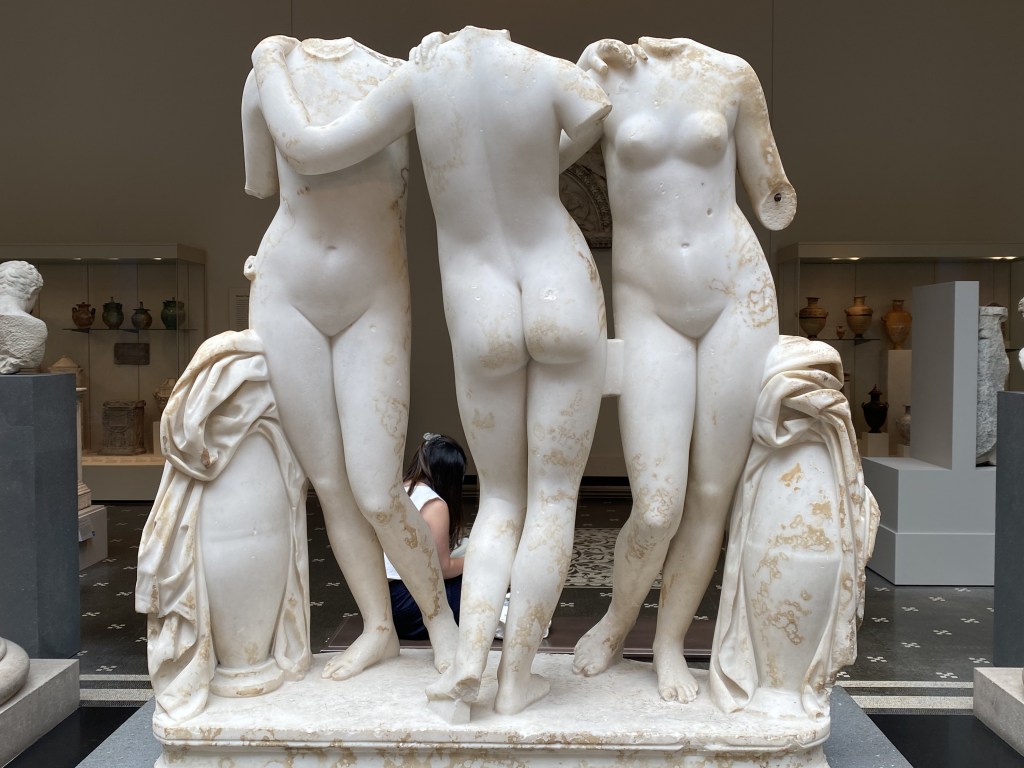
The central, open gallery with the larger statues is light filled and open, with many available benches for resting, or for the dozen others sitting near me, for drawing the statues. There was a guard patrolling the room making sure we were all using some form of a pencil as we drew, or in my case, wrote. He admonished one young man to put away his tiny watercolor set, and another young woman her colored charcoal. I gazed at the Three Graces for several minutes, and subsequently became smitten with Artemis/Diana and a deer. The flow of her gown and the way the deer is gazing up at her transported me to a peaceful field. And made me miss my dog. At the end of the day, we bring our own associations and history into our interactions with art, don’t we? Why do I love the Three Graces so, and why does the fact of my dog make me drawn to a sculpture of a deer? Why do Greek statues feel contemporary compared to Egyptian art of the same era?
I ended my morning with Roman wall paintings, which felt like a revelation – color! On a flat surface! – after two days of statues and amphoras. Some of these paintings were from the Augustan Villa of Agrippa Postumus at Boscotrecase on the Gulf of Naples. The villa was buried in A.D. 79 when Vesuvius erupted and was then partially excavated in 1905. This style of painting, the Third Style of wall painting, a fresco form, moved to flat surfaces and tiny columns, candelabra, and creatures. Vivid color everywhere. There is a three-walled bedchamber you can walk into – I tried and failed to imagine an enormous villa all painted this elaborately, but am mostly in awe and grateful that this artwork was saved from 1826 years under lava.
I came back to my apartment and re-read John Keats’s “Ode on a Grecian Urn” (1819). It feels like a new poem after my immersion today.
 The Met Project