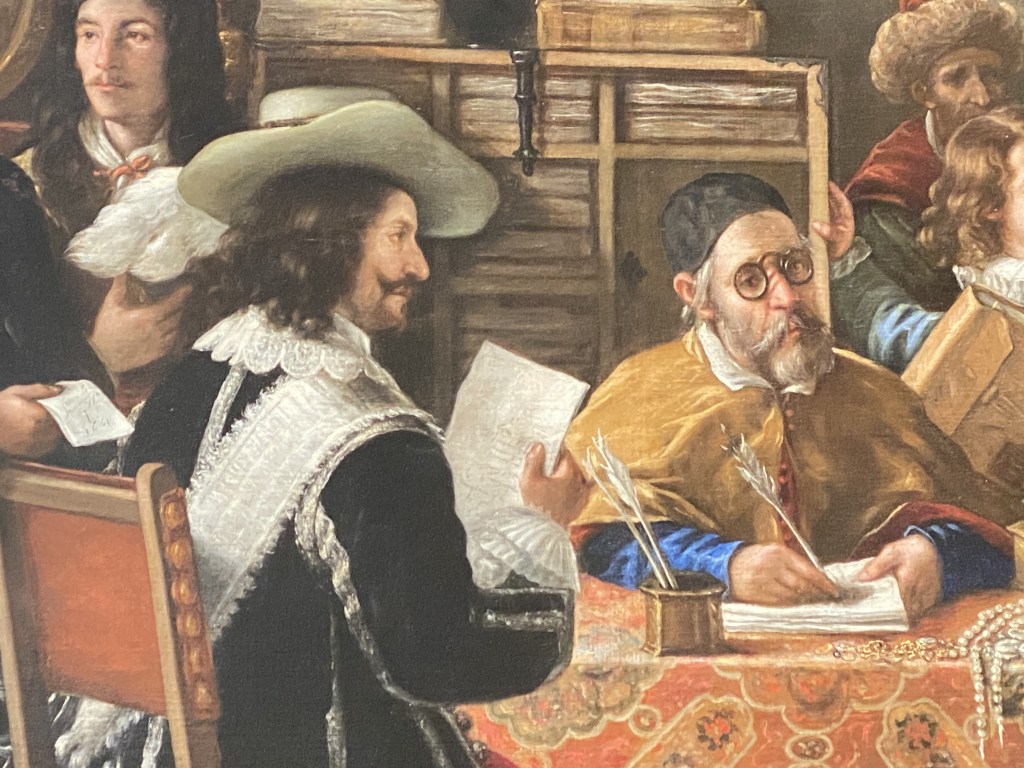
Juan de Pareja
“History must restore what slavery took away.” – Arturo Schomburg, “The Negro Digs Up His Past” (1925)
While I scheduled my days at the Met somewhat randomly based on the number of galleries in each area and other practical considerations, it seemed more than fitting to end up spending time with Afro-Hispanic painter Juan de Pereja on Juneteenth. The Met has owned the famous Diego Velázquez portrait of Juan de Pareja since 1971, as well as others, including “Kitchen with the Supper at Emmaus,” notable for centering a Black figure. This exhibition, however, sheds light on the fact that Juan de Pareja was enslaved by Velázquez for more than two decades. Indeed, most working artists of Spain’s “Golden Age” of art in the seventeenth century had one to three enslaved artisans working with and for them. Spain at that time, Sevilla in particular, was a multiracial society; Juan de Pareja was thought to have an African father and Spanish mother. Many Africans were enslaved there, and just as many were freedmen.
This show merely lays out the facts of the matter, and it is up to the viewer to draw conclusions, although for me it just raised more questions. What must it have been like to sit for a portrait for someone who owns you? You are a literal object. After twenty years of enslavement, de Pereja and Velázquez traveled throughout Italy together for over year acquiring works of art on behalf of King Phillip IV of Spain. What could that relationship have been like? At the end of that trip, Velázquez freed Juan de Pareja, who lived 20 more years in Madrid where he died in 1670.
I haven’t even gotten to the true hero of this exhibit, though: Arturo Schomburg, Puerto Rican collector and scholar of the Harlem Renaissance. Schomburg made it his life’s work to collect and preserve Black literature, artwork, and slave narratives. According to this piece on the New York Public Library’s site, a young Schomburg asked his mother in the late 19th century why African history wasn’t taught regularly in schools. Schomburg might be appalled to know that I am asking the same question in 2023. There were two elderly New York ladies near me in the exhibit, one of whom I overheard say, “I just can’t get over that [slavery] was happening all over the world! Not just here. I just can’t comprehend it.” It feels so profoundly not okay to be ignorant, and yet, it is challenging to become informed. I felt a lot of empathy for those ladies – they really did want to know and seemed upset that this information had been somehow kept from them.
The exhibit includes photographs and pages from Schomburg’s scrapbook of his time in Sevilla, intimate snapshots and captions on black paper. He was extremely interested in the artwork of Juan de Pareja, and made a pilgrimage to the Prado in Madrid to see “The Calling of Saint Matthew” (here on loan from the Prado). Schomburg writes, “I had journeyed thousands of miles to look upon the work of this colored slave who had succeeded by courageous persistence in the face of every discouragement[…] I sat in reverent silence before this large [canvas].” (“In Quest of Juan de Pareja,” 1927) It is an enormous, vibrant painting, in which he places himself amongst all different types of faces, at a table covered with an intricately painted carpet.
My mind immediately went back to the African Origin of Civilization exhibit I wrote about in Day 2 and how we don’t really have a grasp of how integrated our world has historically been. Coincidentally, there was an article in the Times yesterday about how Egypt is mad at a Dutch exhibition that shows how “Black musicians have drawn inspiration and pride from the idea that ancient Egypt was an African culture.” Egyptian art scholars argue that Egypt is Muslim and more Arab than African, “and some feel that it is their culture and history that are being erased in the Western quest to correct historical racism.” I’d like to see that Dutch exhibition. Bit of a commute from here, though.
Cecily Brown
Whiplash with me, won’t you? To the very current work of Cecily Brown, British painter. Contemporary art is more my usual diet, so it was fun to be amongst her energetic, colorful paintings. There were two distinct lanes to her work that grabbed me. The first is the idea of vanity, women sitting at vanities, women with their heads together, always with some sort of skull in the frame. Youth, beauty, and inescapable death. “Aujour’d’hui Rose” depicts two young girls with their heads together, their heads forming the eyes of a skull, described as a double-image memento mori. Untitled (Vanity) continues the theme and drops me right into Sylvia Plath’s “Mirror.” I love these paintings. I would totally hang these in my house. However, slightly out of my budget as her paintings are auctioning around 5 million.This reminds me of the excellent documentary, “The Price of Everything,” that gets into working artists, auctions, and high roller art collectors. It is fascinating and slightly depressing.
The second lane is Brown playing with classic forms, such as “Death and the Maid,” which is a play on Edvard Munch’s drypoint etching, “Death and the Maiden.” Her classic still lifes are wild, such as “Lobsters, Oysters, Cherries and Pearls,” and manage to both mock and revere classical Dutch paintings. She was prolific during the Covid-19 lockdown, “A Year on Earth” perfectly capturing the claustrophobia of that time. It is refreshing to see an entire show devoted to a working woman contemporary artist.
 The Met Project