This morning dropped me back into stunning craftsmanship, influencers, and lots and lots of gilded objects as I moved across the hall from the Renaissance in Italy to that in France. This period featured lead-glazed earthenware depicting watery, creature-filled pond scenes. The artists made casts from actual animal specimens, giving the pottery an otherworldly yet realistic feel. Of course there are many portraits of kings and nobles, including this charming portrait of King Charles IX of France at age 11. He has a slightly mischievous look to his eye – a king but also a child. As in Italy, many of the artists made religious figures their subjects. I’ve always found it curious, although I suppose understandable, that artists would depict religious icons, such as these roundels of the Evangelists, Matthew, Mark, Luke, and John looking like 16th century Frenchmen, rather than the middle eastern men they were.
Gallery 550 centers a pair of realistic Spanish sculptures from and 17th century, “Ecce Homo,” Latin for “behold the man,” the words spoken to Christ by Pontius Pilate before his crucifixion, and “Mater Dolorosa,” a weeping Mary. The fine lines of blood dripping down the Christ figure are echoed by Mary’s tears, binding their connection to one another, offering a deep humanity to the scene of Christ’s Passion. It is no wonder that these sculptures have been beloved objects of contemplation for Catholics throughout the centuries.
Back to conspicuous consumption…
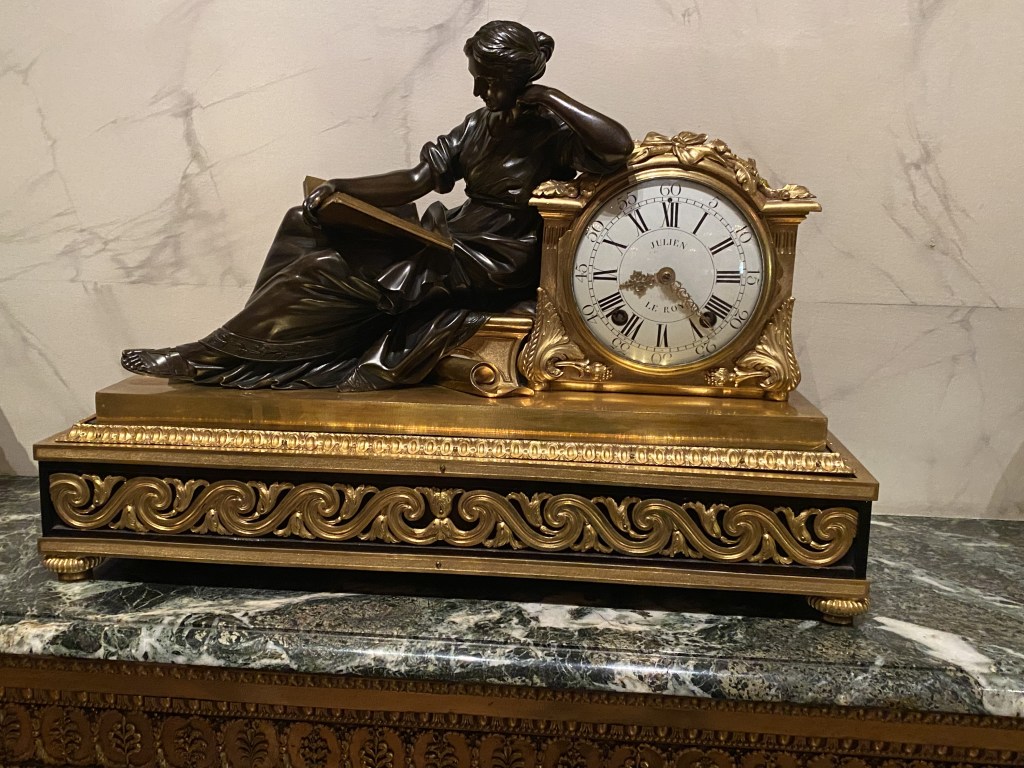
As one moves into the 18th century and the Louis Kings, everything is bling. Room after room is displayed with gilt furnishings, gild oak panels, gilt chandeliers, and every imaginable object, gilt. The way these rooms are set up makes it easy to imagine the life that might have taken place there: a side door ajar lets in a bit of light, a dog bed, games set up on a table, a harp about to be plucked.
I thought that Louis XIV would be the blingy one, but his room was all red velvet, and tapestry depicting him as Jupiter. It was XV who brought the shine. Many of the statues in these rooms depicted Greek or Roman gods and scenes from mythology or from classical Rome. One of the signs says that there was a pervasive thought that the time of the Roman empire was a “golden age.” This is an idea I have been thinking about a lot as I’m constantly hearing people complain that these are the worst times we have ever been in and that we should go back to some shiny, golden days of yesteryear for everything to be better. This sentiment is expressed by people from all parts of the political spectrum. No matter how you choose to measure, this is demonstrably not true, but it is perceived to be so. The New York Times had an op-ed on this a couple of days ago that addresses this topic. Woody Allen’s “Midnight in Paris” does, too.
Nobles and other wealthy citizens collected beautiful objects and attempted to be influencers in a way not dissimilar to those on the Internet in our age. Did you hear that Marie has an elephant vase? I’m totally getting one too! And a snuffbox with a portrait? Totes getting that. Demand drove sales as always, and many more of these luxury goods were manufactured. I’m only on day six of this project, and all I can feel is, oh, humans, sweet, silly humans, you are so the same, always.
Some other favorites from the section included a pair of Leda and the Swan sculptures, one sweet, a swan snuggle, and one violent, a swan neck-wringing. The wall of porcelain birds made me giggle.
European Sculpture and Decorative Arts comprises 60 galleries, and it is truly impossible to take it all in, but I enjoyed it and got more out of it than I expected. It left me, in the midst of thousands of luxury items, that I thought would feel cold and remote, feeling connected to humanity’s history and its constant longing to matter – to make something that matters – to believe something that matters – to leave a sense of itself on the world.
 The Met Project