Every visitor to the Met has to walk through Ancient Byzantium to get to most of the other galleries, but very few people were observed to linger there. My first impression of the art was that it met my stereotype of medieval times: heavy metals and practical war-related objects, including horse bits and ornaments for riding into battle and precise weights for measuring goods. This was the time of the rise of Christianity and establishment of several Coptic Christian monasteries in the Egyptian and northern Africa parts of the empire. There was still a secular influence in the upper classes, though, especially when it came to education and school, the word school deriving from the Greek word for leisure as only the wealthiest had uninterrupted time for thinking and learning. This leisurely learning led to the concept of paideia, a pedagogy emphasizing rhetoric, philosophy, and music. Much of what was being read was on ostrakon, slabs of broken pottery (English teacher fun fact: that is where we get our English word ostracize because broken pottery was thrown over the city walls.) These were incredible to see: Bible verses, hymns, personal letters, poetry. My companion for the day quipped that the mailing costs must have been outrageous for those letters.
Most of the objects on display had a purpose, and for the vast majority that purpose was religious. Meanwhile, Islam came forcibly into Egypt in 641/642, as did the never ending battle between religions. Feelings about religious icons were all over the place, valued and revered, then banned completely for about 150 years until around 800, when they were firmly reinstated. And, as with the Protestant Reformation, when in doubt, destroy the icons. What I don’t think I fully appreciated until today is the intrinsic and actual power they believed these icons possessed. They were so much more than symbols.
The middle Byzantine era, spanning to the Crusades in the early 13th century, included more battles over icons and the rise of many more skilled artisans. All of these artists were working for the church, so all held Roman Catholic significance, and the only other citizens who could afford them were the very wealthy, so all of these were unattainable to the average medieval person. Some highlights include the Attarouthi treasure chalices, stunning mosaic work, Limoges enamel work, many, many crosses, which were considered protective against demonic activity in the home, and some truly lovely pottery – the bowl with a long-beaked bird a favorite.
Statues of Saint Catherine of Alexandria appeared many times here and throughout the Met, always with her foot on the head of the emperor Maxentius. The legend goes (most scholars have disputed any historical accuracy to it) that Catherine, a princess and a scholar, converted to Christianity at age 14 after a vision and continued to convert others. Maxentius ordered her to convene with 50 philosophers who were meant to convince her to renounce her faith. She did not. Maxentius then tried torture and imprisonment. Also did not work. He then said, well, hmm, instead, why don’t you marry me? As tempting as I am sure that was, she denied him, affirming her intention to stay a virgin bride of Christ, so he ordered her decapitation. She said, no, I am ordering my own decapitation, and then when she was beheaded milk flowed out instead of blood.
There are at least three late medieval statues of saints sitting on slain dragons (George, Michael, and Margaret), the dragon supposedly hiding Satan, which is I guess why slaying a dragon is such a prominent trope.
I can’t emphasize enough the fluidity between the objects and the spiritual significance they held for people. The chalices that held holy water and oil were themselves sacred. One that struck me as especially interesting and strange was the Reliquary in the Shape of an Arm, a place to hold the bones of the saints, this one holding bones of Saint Fiacre, a healer who died in Meaux, France, the site of his cult until the French Revolution. To touch the object was to touch a form of God.
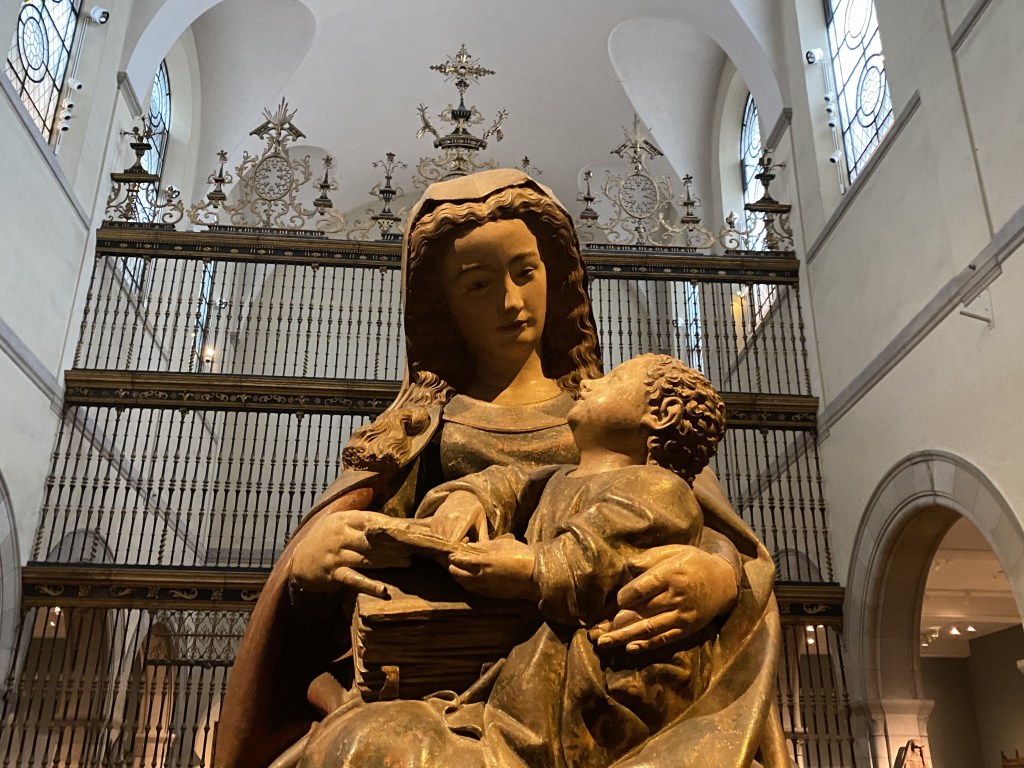
The truth is that medieval times were rife with violent conflict, almost all of which was religiously motivated, a millennia of a churning, bloody world trying to sort itself out in religion and territory and power. These icons reflect that and the accumulation of extreme wealth by the church. And yet, there is evidence of personal and reflective experiences of faith, such as this folding shrine, used for individual contemplation and prayer. The many depictions of Mary and child vary in depiction, most depicting baby Jesus as a small middle aged man – had these artists never seen an actual human baby? Or did it seem disrespectful to depict Jesus as an actual human baby? This one is lovely and tender.
I’ll end with a favorite of the day, not exactly medieval, rather German from about 1520, but housed in the medieval gallery: Female Saint with a Book. She is conspicuously stylish, reading a book, and as such, conveying a high status. German church reformers called such statues “whorish.” Because how dare she?
 The Met Project