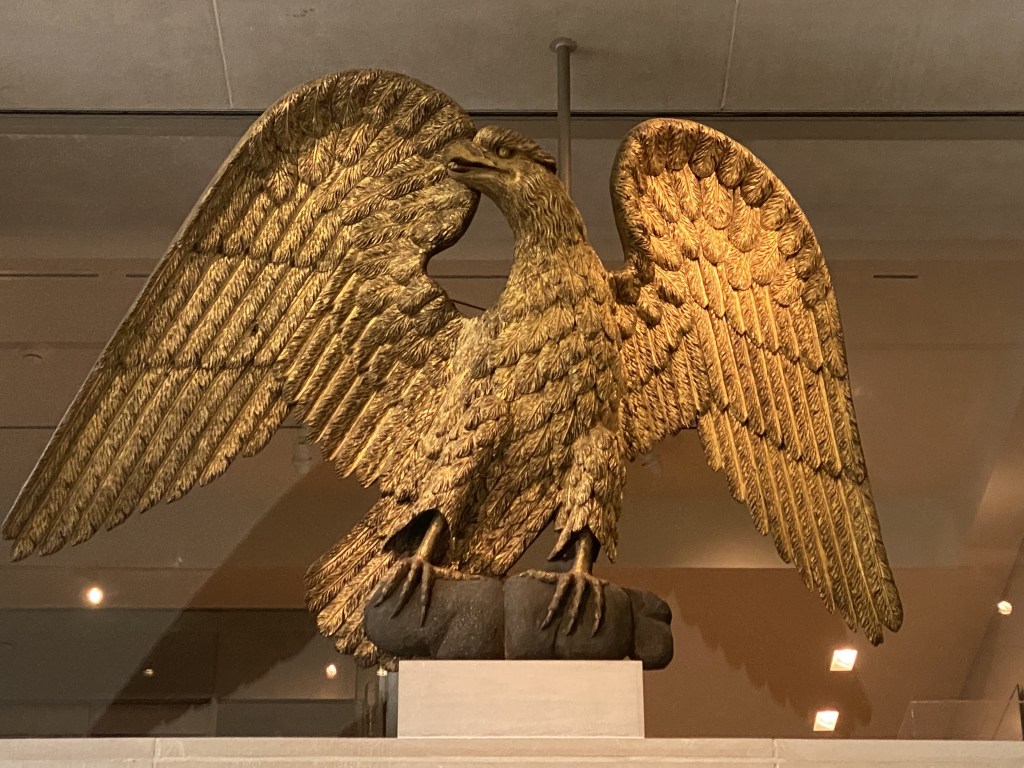
The American Wing is flanked by courtyards, one on the west side of the mezzanine level that features ceramics, and the other around both sides of the second floor, which contains more ceramics, glass, silver, metalwork, and jewelry, each side offering an entrance into the vast American painting and sculpture galleries.
Let’s begin with ceramics, the exhibit containing ceramics from 1876-1956, with a few surprises. The earlier ceramics imitated popular European styles like this Jardinière from 1876, which shows a man at a potter’s wheel in a distinctly Wedgwood style. I was taken aback in a good way by George E. Ohr’s works from the late 19th century, paper-thin, unglazed and strangely twisted bowls that looked entirely modern to me. I adored all of the Arts and Crafts pottery, especially this vase made by the Paul Revere pottery company out of Boston. And this vase by Roseville pottery from Ohio. The pots get wild as the exhibit ends with the emergence of studio pottery, including this one by Peter Voulkos in 1955. Oh, and also this snake jug. And also Marie Zimmerman’s Bowl and Stand – love this!
Up a flight of stairs, and the first thing I saw was this Chatelaine. I had to look up what that is – it is a set of short chains attached to a woman’s belt for carrying keys or other household items. Possibly the coolest thing ever. The two sides of this courtyard balcony contain so much glass. And so many different kinds! There is blown-molded glass, pressed glass, cut glass, and art glass. A lot of silver and metalwork, which I will admit to not exactly being drawn to, but Tiffany Co., incorporated in 1837 shows up throughout, and I like what Tiffany artists made, this time in silver: a cigarette and match case set, cups and saucers, and this darling tray with a frog on it. The last item I will note from this vast array of what would make antique store fans faint with joy, is the Tiffany Magnolia Vase, created for the World’s Columbian Exposition in Chicago in 1893. It deliberately contains images and craftsmanship that represent every part of the United States and was uniformly hailed by art critics. It is stunning and enormous.
The main attraction on the second floor of the American Wing are famous paintings, the most popular one, of course, being Washington Crossing the Delaware. I am pretty sure that I am the only visitor who did not take a selfie with this gargantuan painting. The Met smartly put it at the end of a big, open gallery since that is where the crowd forms. Everyone seems to be here for this. It is impressively large, enough for a big group selfie in front of it. The other immediately recognizable painting is John Singer Sargent’s Madame X, Madame Pierre Gautreau’s name redacted when the painting was first displayed to the public as her skimpy attire was scandalous. I preferred Sargent’s The Wyndham Sisters, which the Prince of Wales liked so much he dubbed it “The Three Graces.” The sisters’ dresses flow into one another, a jumbled confection of 19th century femininity that seems to have floated to the bottom of the canvas like a pile of white feathers. I hadn’t realized that Sargent dabbled in Impressionism, but he did, as seen in The Hermit, completely diverging from his portraits.
There are a lot of portraits here, the most compelling of which, to me, were paintings of children. John Singleton Copley has two portraits of young boys: Midshipman Augustus Brine, a 12-year-old having just enlisted in the Royal Navy, looking totally up for it; and Daniel Crommelin Verplanck, a 9-year-old aristocrat enjoying some playtime with his pet squirrel. Another painting of children that moved me was The Alling Children by Oliver Tarbell Eddy, which was painted to commemorate the death of a son, who is painted separated to the side of his surviving sisters, both in composition and in light.
There are a couple of galleries of Latin American art. I love all of the Nicolás Enríquez pieces – so modern in feel to me, yet this one painted in 1773. Another gallery shows unnamed paintings from colonized Peru, like this large canvas, Our Lady of Valvanera, painted in the Cuzco style around 1770.
I was intrigued by the 1773 portrait of William Duguid painted by enslaved African artist Prince Demah. His owner, merchant Henry Barnes noticed that he had talent and took him to London where he studied briefly with Robert Edge Pine. His paintings (three remain) are the only ones to have survived by an enslaved person working in colonial America. Through more tour guide eavesdropping I learned that when they returned to the colonies from London, Prince Demah was made to work in a watchmaker’s shop who sold Demah’s services as a portraitist. The loyalist Barnes family fled back to England in 1775 during the Revolution but Prince Demah remained, writing papers identifying himself as a “free Negro.” He died in 1778.
A word I am seeing often in descriptions of artwork is “complicated.” The “complicated” history of the American West. The “complicated” history of enslavement and freedom of Africans in America. The “complicated” American perceptions of Native people.
America’s relationship status with the enslaved and exploited: “It’s complicated.”
As with the Libyan Sibyl from the sculpture garden I wrote about in yesterday’s post, many artists grappled with both the events and tensions of their time and their understandings of the past. Many of the works in the American Wing do this. Some that stood out to me include: Albert Bierstadt’s The Rocky Mountains, Lander’s Peak, an ode to Manifest Destiny; John Steuart Curry’s searing portrait of John Brown; Thomas Waterman Wood’s A Bit of War History: The Contraband; The Recruit; The Veteran, a triptych honoring soldiers in the so-called U.S. Colored troops that made up more than ten percent of the U.S. Army and Navy in the Civil War. (And sorry, the Met link only shows The Veteran…)
What struck me again as I wandered these galleries was that American democracy is truly a “great experiment,” a flash in time compared to the ancient civilizations represented elsewhere in the Met, and even Europe, really. Some of the paintings are full of bluster and confidence, some are embarrassingly misguided, others are like a child trying on its mother’s dress to see how it feels to be an adult, while many are simply painting deep and personal truths: the love of a beautiful woman, a breathtaking landscape, the death of a child.
 The Met Project