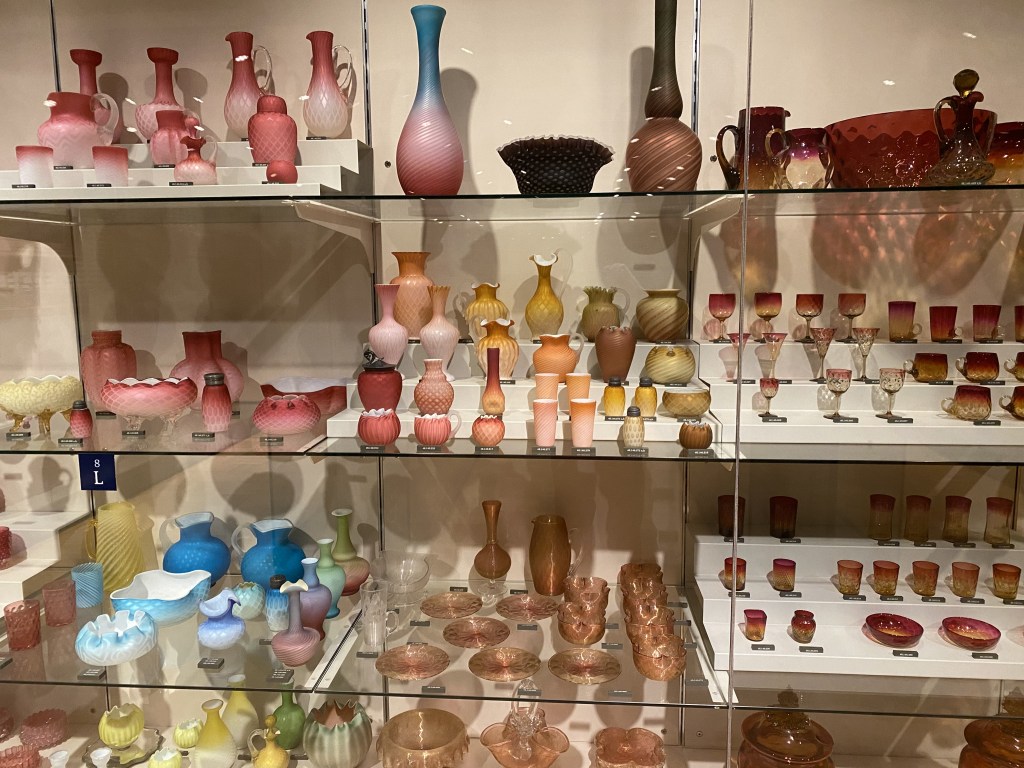
I wrapped up my time in the American Wing wandering through the Henry R. Luce Center for the Study of American Art, a vast, open storage area that anyone is free to explore, and is also a tremendous resource for anyone studying American art. It is magical. The objects and paintings are in various stages of disarray, such as many tattered pieces of furniture, while other items and paintings look ready for display in the main galleries. It feels a bit subversive to walk the aisles as no one has curated any of this beyond clumping all of the grandfather clocks together, or the pink glass, or the plain wooden chairs, or the silver pitchers, or the animal sculptures. Everything is artfully crammed into large glass cases, thousands upon thousands of beautiful and odd things to look at and hardly anyone is there. I fell in love with this screen, wildly covered in porcupines as well as a pitcher with a dragon for a handle, for which there is sadly no link. The groups of statues were entertaining to gaze upon as they appeared to be interacting with one another. A female in marble gives side-eye to a bust of Abraham Lincoln, who is being stalked by a sea lion. Then one suddenly comes upon this stark and lovely John Singer Sargent portrait of an Egyptian woman. Why is this in storage? Around the corner from so many spoons? I will return to these storage cases again before my project is over. There is something compelling about the abundance and clustering of it all.
Next to the storage area is a display of just a few of the 30,000 baseball cards donated to the Met by Syracuse electrician Jefferson R. Burdick. He began collecting baseball cards when he was ten years old, and over the course of his life collected more than 303,000 pieces of baseball memorabilia, all of which he donated to the Met. You can read more about him and the collection here. There were baseball cards dating back to 1887, which was delightful for my husband, who has joined me this week, as he plays on a Vintage Base Ball team in Berkeley, which follows 1886 rules and uses 1886 equipment. The collection also displays clippings of game recaps, including plays and summaries such as: “STRIKE. Caught napping by a sizzling straight pitch. Frank Crossetti – Frankie, it is said, started to learn the art of batting when a boy by swinging a home made bat against corncobs tossed up by an older brother. It’s landed him the regular shortstop berth with the Yankees.” Or an enthusiastic, “!!HOME RUN!! A TERRIFIC drive into left field bleachers! It’s over 400 feet out there. Paul (Big Poison) Waner – rated among the truly greats of the game. Came to the Pirates in 1925, and hit for .336 his first year. Led his league with .380 in 1927 and .362 in 1934.” It doesn’t get any more American than that. We look forward to watching the surging Giants trounce the flailing Mets at Citi Field this weekend.
As we made our way out through the mezzanine, we stopped to again admire the octopus chatelaine I came upon yesterday, but discovered I had some competition. It was being examined by a 5-year-old boy there with his mother. The child had a list with him, and told me he was specifically looking for an octopus. I showed him my octopus sleeve tattoo. His response was, “Cool. Do you also have a falcon or a cheetah?” I assume those were also on his list. We left him, his sketchbook out, carefully drawing the octopus chatelaine. What a smart way to bring a young child to an art museum!
I’m sorry to offer you a shorter than usual post today, dear reader, as the third floor of the American Wing was unfortunately closed.
 The Met Project