It is the Sunday of the July 4th holiday weekend, and the museum is an absolute madhouse. It seems like a good time for me to recommend a couple of hacks for you if you ever visit the Met in the high tourist season. The “Members Only” entrance at 81st street, just to the left of the iconic, sweeping stairs, is open to the public. There is hardly ever a line and you can buy a ticket there. Snooty members like me might harrumph and give you some side eye, but you are perfectly free to enter there. There are three bathrooms down there on the ground floor. The best ones are hidden at the end of the corridor with all of the children’s artwork to the left by the classrooms. They are clean and usually empty. The soap in the bathrooms at the Met smells delicious – minty and refreshing as you wash up after a sweaty walk through the park. I am obsessed with this soap.
There are areas of the Met that are profoundly less crowded than others, which is why today was a perfect day to visit Islamic Art. There were plenty of visitors, but I was able to take my time and wander through 1600 years of exquisite art. One of the most interesting aspects of Islamic art history is the way in which the art reflects the diversity in the Islamic world over time and the various artistic collaborations and influences upon it. This is an area of the museum that I am positive I would overlook on a casual visit. It is tucked away in the southeast corner of the second floor and contains wonders.
The art of calligraphy has long been valued in Islamic cultures, primarily because of the importance of the written word of God, the Qur’an. There are several beautiful examples of this here, including this ornate one from West Africa created in the 19th century, in maghribi script with an embossed leather cover. There is also this large format folio from the Qur’an of ‘Umar Aqta,’ one of the largest every produced, each line of script over three feet long. Finally, is this Qur’an manuscript from the Ottoman period on a teak stand from Iran from 1360. Persia was known for its tradition of literature and poetry, the most famous being Rubaiyat of Omar Khayyam. The Islamic art galleries include many examples of illustrated stories with seats in front of each to invite the viewer to spend time with them. I especially loved Alexander the Great and Dying Darius and this gorgeous binding and text of Persian poetry.
It was interesting, especially with ancient Greece, Rome, and Egypt under my belt, to see how those cultures influenced Islamic artistic expression. One can see the Greek influence in this Ring-shaped ewer. Luster ceramics were brought to Syria from Egypt, and from there to Muslim Spain and Italy. This Bowl with Two Facing Peacocks comes from the late 10th century. There is case after case of insanely beautiful pottery, turquoise (French for Turkish!) glaze the most prevalent, believed to ward off the “evil eye” and more practically, easier to manufacture and fire. They are so pretty! Look at this Cup with Running Ibexes! Or this jar. Or this Luster Bowl with Musicians in a Garden – the intricate painting on that one!
Beyond the ceramics there is a lot of glass. I’m imagining all of the glass and ceramics from the American Wing sneaking down to the Islamic Art corner in the middle of the night hanging out, talking cuts, enamels, and glazes. They’d have so much to discuss! I think any blown-molded glass of early America would be honored to meet this enameled and gilded long-necked bottle from 14th century Egypt (or maybe Syria). This 9th century bowl in the Millefiori technique, glass, mosaic, slumped, ground, and polished would be the belle of the ball.
Another motif in the galleries here are incense burners of all shapes and sizes. The biggest one was this guy, of Amir Saif al-Din Muhammad al-Mawardi. The head is removable to allow for the coal and incense to be dropped in. There are smaller ones, too, like this bird-shaped one. Birds were everywhere, my favorite, not surprisingly, was this Iranian Figure of a Predatory Bird. One of the things I appreciate most about the art and sport of falconry is how it is thousands of years old and exists in almost every culture. This painting of a Prince Holding a Falcon with his heavy lidded eyes and expression says it all.
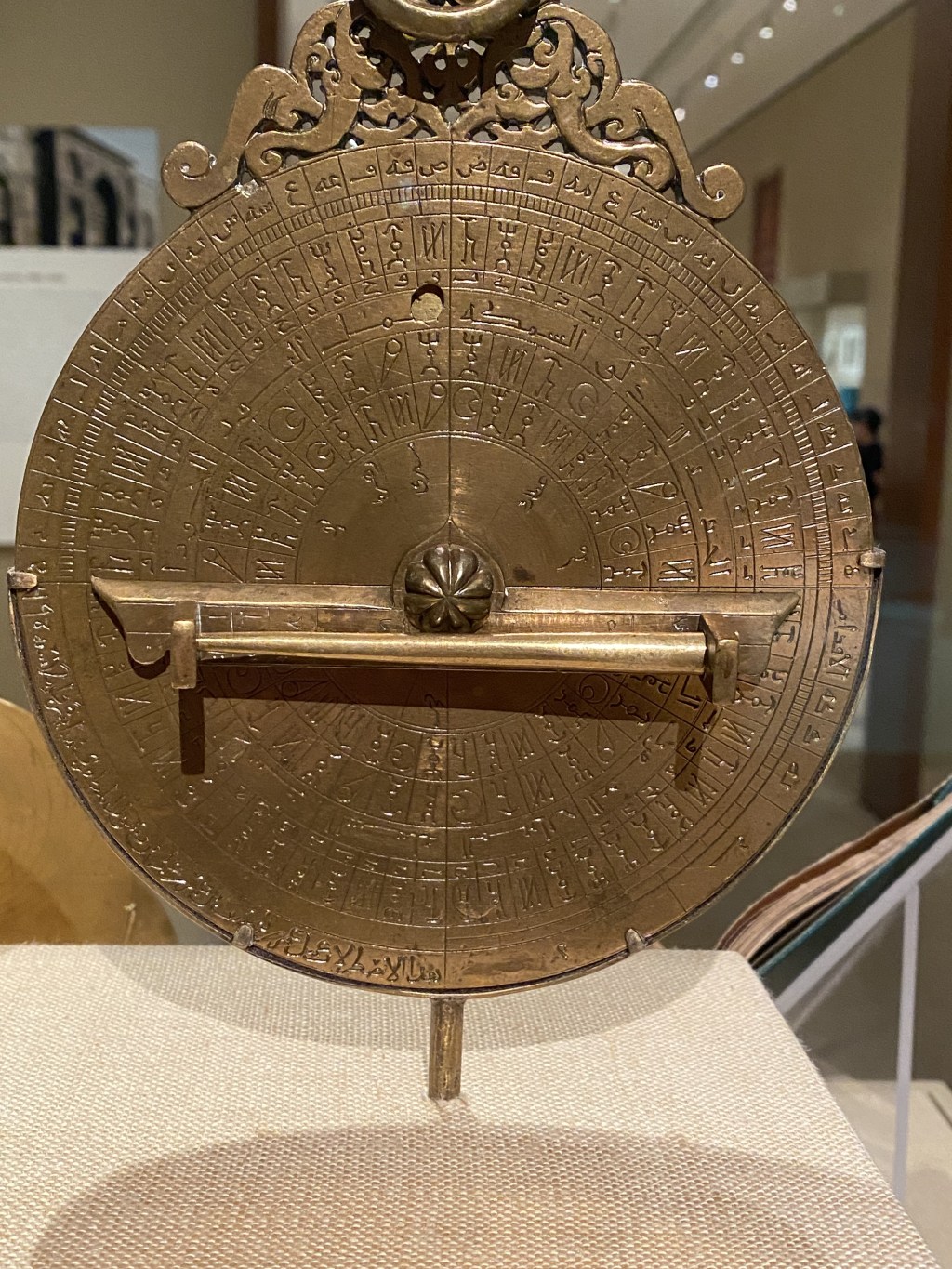
It is well known that Islam has given the world a tremendous number of intellectual and cultural gifts, from philosophy to music to medicine to science. The game of chess, for instance – here is one of the earliest chess sets in existence from the 12th century. My husband and I became obsessed with astrolabes, the second oldest scientific instrument ever created, an astronomer’s star map of the known universe at the time. This one was made by scientist and Rasulid prince, ‘Umar ibn Yusef, in 1291. Here is a digital astrolabe that is super fun to play with. Please enjoy this opportunity to procrastinate whatever it was you were doing!
It isn’t Islamic art without the carpets and tiles. This Animal Carpet, for instance, which contains 800 knots per square inch. The “Anhalt” Medallion Carpet is exquisite as is this Bird Carpet. Many of the carpets are in a huge gallery in which the ceiling is from 16th century Spain. The adjacent room is blanketed with colorful tiles such as this one from the early 17th century.
A small corner of the Met, teeming with treasures. I could go on and on and link a hundred more images, but here are just a few more favorites:
The Damascus Room, a reception chamber (Qa’a) is from a large palace, ornate and yet soothing with a bubbling fountain at the foot of the sitting area.
This Allegory of Worldly and Otherworldly Intoxications.
This Mihrab (Prayer Niche), today’s popular selfie site, which was a little gross to me considering its intended use.
Once again, in doing this project, I am struck by the interconnected cultures from all around the world. We think of capital-g Globalization as a new thing, and in its current iteration I suppose it is, but we’ve always been one world.
 The Met Project