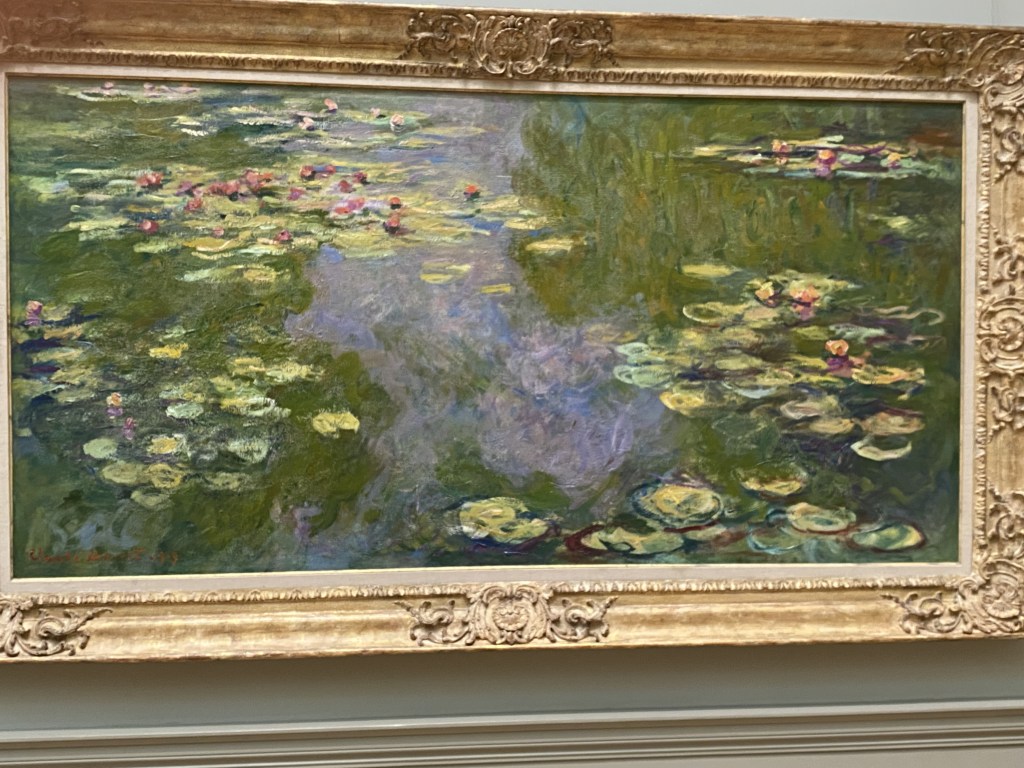
The Met has a vast collection of Impressionist art and so much Monet. I like Claude Monet, but if I’m being honest, I associate his Water Lilies with umbrellas and scarves – they have stopped being themselves and morphed into a decorative stereotype. I am grateful for my morning with a vast spectrum of his work today, though, especially on the heels of yesterday’s paintings. He was a true radical. When he started painting in the 1860s, he was known for his broken brushwork and highly saturated color, inspired by Japanese prints and then moved primarily to landscapes in the next decade. This early painting, Garden at Sainte-Adresse from 1867 is a good example of the Japanese print influence. He quickly moved on to landscapes; two that pleased me are Spring (Fruit Trees in Bloom) and The Parc Monceau. You can see his shift to more abstract renderings and iterating to the paintings we think of as “Monets” in Véthueil in Summer, the town he moved to in 1878. I’m not usually much for a floral still life but his Chrysanthemums are gorgeous. He painted the cathedral at Rouen many times – this one, Rouen Cathedral: The Portal (Sunlight) is lovely – the paint is so pale as to be almost completely washed out and yet conveys such warmth. There are, of course, several Water Lilies – not the enormous mural size panels on display in Paris, but still large. Bridge over a Pond of Water Lilies from 1899 evokes the pastel coolness of what I expect, But this one, Water Lilies from 1916-19 is essentially abstract and gives a completely different feeling. I do not feel tranquil gazing at this one. I had to laugh – these artists and their egos – Edouard Manet is quoted as saying, just as Monet was coming into his own style: “Who is this Monet whose name sounds just like mine and who is taking advantage of my notoriety?” I mean, I don’t see any Manet umbrellas, so…
The Pissarro room was fun for many reasons, not the least of which was the puppy pile of sweaty students (still hot and humid today) sitting on the floor quietly sketching. I did not mind having to step over them to see Pissarro’s blatantly leftist, political, and beautiful paintings. He was known for painting peasants like this one, Two Young Peasant Women. He was a mentor to both Paul Cézanne and Paul Gaugin.
The Met’s most famous Van Gogh, The Starry Night, is in the special Cypresses exhibit, but they have several more. I was tickled to see Van Gogh’s First Steps, after Millet, his own take on the Catel I posted yesterday. This post-Impressionist gallery also contains a Rousseau, The Repast of the Lion, which feels entirely different from anything else in the room. Gaugin carved a walking stick when he was in the Marquesas Islands, which is in the gallery. The shaft of the stick is entwined with a snake, the handle is a female nude, which supports a Breton shoe at the top, which conceals a secret compartment. I also loved Morning, Interior by Maximilien Luce (strangely, no Met link), a painter previously unknown to me – gorgeous light created in the pointillist style.
Paul Cézanne also gets his own room; his still lifes make me feel nostalgic – we had a print of one in our house when I was a child, similar to this one, Still Life with Jar, Cup, and Apples. He also painted what seems to be a still life of humans, The Card Players. And his landscape of The Gulf of Marseilles Seen from L’Estaque is so pretty. The south of France was the place to be. Until it wasn’t and became all about Paris!
Three large galleries comprise the Annenberg Collection. Apparently, Americans were mad for Impressionist paintings, a madness continued by the Annenbergs who collected a bazillion dollars worth of paintings from the 1950s to the 1990s and very nicely donated them to the Met. They stipulated that they be displayed in a particular way, that I’m sure makes sense to them, perhaps as the paintings were arrayed around their mansion, but it struck me as pretty random. In any case, they had good taste. Some of my favorites include the massive Renoir, The Daughters of Catulle Mendès. This was a commissioned painting by a famously bohemian family; Mendés was a Symbolist poet and his wife, Augusta Holmès was a virtuoso pianist. There is speculation that Renoir was counting on their reputation to make the painting a success but people were apparently unenthusiastic about it. I like it; the girls look smart to me. The Annenbergs had several Van Goghs, including Shoes, painted during the time of the cypress paintings in Arles and Olive Trees from the same time.The last Annenberg gallery is devoted to more of their vast collection such as Picasso’s At the Lapin Agile and George Seurat’s Grey Weather, Grande Jatte, a classic example of pointillism.
Painters who came out of the prestigious Academie des Beaux-Arts often promoted their paintings in the Paris Salons, smooth in style and idealized in subject matter, called academic or Salon painting. I have always loved loved loved Joan of Arc by Jules Bastien-Lepage and thrilled to see the large painting in person. The blend of her stance and facial expression, so stark and realistic looking with her golden avatar behind her, and the saints coming in. I am drawn to art that makes me a tiny bit uncomfortable, that glues me to the spot. This does. There was another painting in the Salon style that I somewhat breezed by; then I saw it again from a distance on the other side of the adjacent gallery, and it was glowing. I went back over to gaze at The Three Sisters by Léon Frédéric.
Finally, the last gallery featured paintings from other parts of Europe. This Inferno by the German Franz von Stuck is sooooo dark. In contrast, Austrian Gustav Klimt’s portrait of nine-year-old Mäda Primavessi, (who lived until 2000!) is joyful and uplifting in her serene confidence.
I walked through the Bernice Abbott photography, black and white snapshots of 1920s New York City, but I couldn’t stop seeing the filthy carpet in there, so I didn’t hang around. I walked through the large scale Richard Avedon murals that elevate group photography to another level with three panels from the late 1960s: Andy Warhol’s Factory, generals and other higher ups from the Vietnam War, and the Chicago Seven, from which Bobby Seale is absent since he was imprisoned. Avedon leaves a space. The way these three panels speak to each other in the small gallery is stimulating and unnerving.
I finished my day in the Drawings and Prints hallway, which is a freeway between the Met Store and the Monets and the Lagerfeld special exhibit. Before I had been smashed into one too many times by an oblivious tourist racing to the next thing while texting, I did notice a few special items. The first is a print by Wendy Red Star, (Whitney link is way better) who has taken an 1880 photograph of Pretty Eagle and created an inkjet print of it which she has annotated in red. It is powerful. There is an Edvard Munch woodcut, Mystical Shore that he made depicting a summer home. I was astonished by this 15th century German hand-painted woodcut of Saint Bernard Vanquishing the Devil. Right before I couldn’t take any more jostling, I was able to enjoy a few drawings that were studies for stained glass windows like this design for an angel of faith window by Tiffany designer Frederick Wilson and his design for a triple-light window. It says these are not on view, but they are.
My heart skips a few excited beats each and every time I enter the museum, but on a crazy busy day like this, I am just as happy to dance on out into the heat.


