The Lehman Collection occupies a triangular space on the ground floor, down the stairs from Medieval art, situated around a sunny courtyard. The Dutch Masters exhibition is contextualized by the effects of the Netherlands’ 80 year war with Spain, which ended in 1648 and resulted in the establishment of an independent Dutch Republic. The Catholic Spanish Netherlands continued in what is mostly Belgium. The introduction also acknowledges that the acquisitions in this collection contain a massive blindspot in that there is no evidence whatsoever of colonialism, slavery, and war to be found in these paintings, even though that was the backdrop to their lives. The paintings are organized by theme and controversy. The first set of paintings are portraits celebrating Dutch independence. I was intrigued by The Van Moerkerken Family by Gerard ter Borch the Younger, in its unusual composition. The wife is placed on the left, traditionally the male power position; the husband is showing her a pocket watch, a more dynamic, and prosaic scene than is typical. There are many portraits in this collection, but I have to say, the Rembrandts have a finesse and sheen to them that make them stand out. Yeah, I know, it’s Rembrandt; everyone knows he was a great painter, but seeing his works next to lesser ones carries the point. For instance, look at the ruffle on this Portrait of a Man. He got a lot of flack, much like Courbet’s realistic nudes from the 19th century, for painting non-idealized female forms. His Bathsheba has a very realistic body, down to garter marks on her left shin (although, I’m pretty sure Bathsheba didn’t wear garters but that’s another issue…). His portrayal (yet another one!) of Medea is also interesting, as she looks like any average Dutch lady, bummed out and contemplating mass murder. These renderings made these women of ancient lore more sympathetic and relatable, but his audience wasn’t into it. I was shocked to find out that Rembrandt died in poverty. Like Van Gogh, he never knew he was Rembrandt.
I was delighted to see two paintings in this collection by women, one by Rachel Ruysch in collaboration with Michiel Van Mussher. The painting is of Rachel Ruysch in her studio, but she painted the elaborate flower arrangement. The other is A Vase of Flowers by Margareta Haverman. Women had little to no access to nude models so became still life specialists.
I do love Vermeer, as do so many, and these did not disappoint. His Young Woman with a Water Pitcher is a perfect example of his quiet interiors, and interior lives, but I did not expect his Allegory of the Catholic Faith. Still an interior, but with heightened emotion. Vermeer converted to Catholicism when he married, but in the Dutch Republic, all objects such as chalices, missals, and crucifixes, used to celebrate mass, were removed from churches, and Catholics were forced to worship in “hidden churches” in private homes. His painting depicts the eventual triumph of the Catholic church.
Onward to Modern art! This was like visiting old friends. The formative art history course I took at Cal in the mid-1980s covered this period, and I giggled to myself about the know-it-all essays I wrote about some of these paintings. I will confess a mild obsession with and total idealization of Paris in the 1920s and the lost generation. The Met has the classic Pablo Picasso painting of Gertrude Stein, and I do so admire her and the way she nurtured artists and made her home a salon, art gallery, and hub. Gertrude was living her best life with Alice B Toklas, no matter how she may have bagged on Oakland. I forgive you, Gertrude. I remember writing about Picasso’s Still Life with a Bottle of Rum, and I’m sure I had many profound things to say about his use of letters. Right next to it is his friend Georges Braque’s Still Life with Banderillas, both paintings from 1911. Perhaps they spent too much time together? I had forgotten how much I adore Juan Gris’s collages! His The Man at the Café is so fun, the newspaper reads: “The Bertillon Method / One will no longer be able to make fake works of art.”
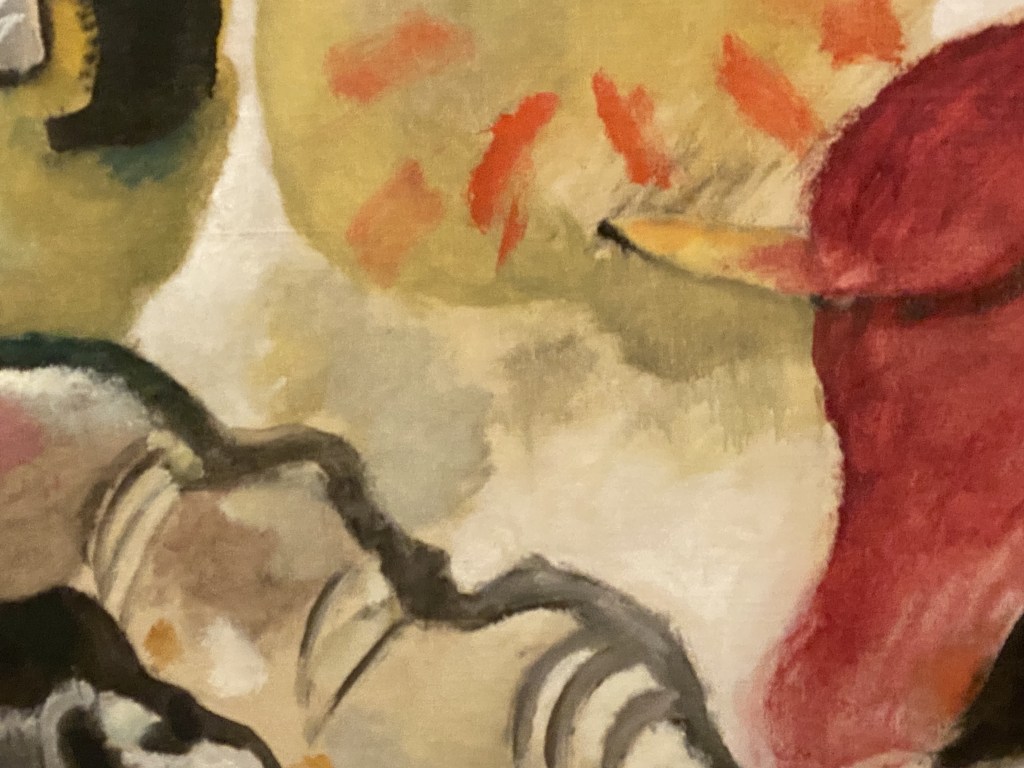
So much of modernism is about technique and more isms, such as Henri Matisse’s Lilacs where he played with the way painted light can make an object disappear. Vasily Kandinsky, early pioneer of abstract painting aimed to depict the spiritual, emotional, and even musical through his forms. Here is his Improvisation 27 (Garden of Love II) where one can just make out the embracing couple. Georgia O’Keefe was a force unto herself with her flowers and bones. She has a whole gallery. Around the corner is Harlem Renaissance Painter Charles Henry Alston’s Girl in a Red Dress, which indeed satisfies Harlem Renaissance philosopher Alain Locke’s dictum that “art must discover and reveal the beauty which prejudice and caricature have overlaid.”
When I was in high school I dated a boy for a while. a painter who was obsessed with Salvador Dali. Obsessed to the point that he influenced me to read numerous biographies of Dali, and at one point asked if he could call me Gala, and I would then be his muse as Dali’s wife Gala was to Dali. There is truly no limit to the pretensions of smart and talented teenagers. I was delighted to find Max Ernst’s portrait of Gala Éluard from when she was married to the poet Paul Éluard before she was married to Dali. Max Ernst lived with Paul and Gala in a menage à trois for a time. The painting is based on a photo by Man Ray. I’m telling you, Paris in the 1920s – oh the drama! Across from Gala is Dali’s later painting Crucifixion (Corpus Hypercubus) from 1954 where Gala appears at the bottom as a witness to a Christ who is healthy and fit looking and seems to have transcended any harm to his body.
I ended today in a gallery of very contemporary art in the Mezzanine, which blew me away. The curated collection is called Knowledge of the Past is the Key to the Future after the painting of the same title by Robert Colescott. All of the paintings here do what the Dutch Masters were not yet ready or prepared to do: they tell the truth. Kerry James Marshall’s Untitled (Studio) from 2014 is a vibrant depiction of a Black artist’s workshop. Marshall tells the story of visiting the studio of his artist idol Charles White when he was in seventh grade and realizing, being in that space, that this was a life possible for him. Oooooh, I am suppressing a rant, but I will leave it at this: young people need to see people who look like them in all of the places of art, business, medicine, politics, and power that exist in this country.
There are so many powerful paintings here: Philip Pearlstein’s Entrance to Lincoln Tunnel, Night-Time from 1992 and Martin Wong and Miguel Piñero’s Attorney Street (Handball Court with Autobiographical Poem by Piñero) from 1982-84 are both works celebrating the beautiful chaos of New York. Titus Kaphar’s haunting Contour of Loss depicts a mother holding a child, which has been cut out of the painting with a razor blade, powerfully speaks to the loss of Black children to violence. That one gutted me. Finally, I spent a good bit of time with Nicole Eisenman’s The Abolitionists in the Park, finished in 2022, inspired by “Occupy City Hall,” a month-long protest organized by the Black Lives Matter Movement. The painting beautifully celebrates people of color, queer people, transgender people, and allies of all kinds who continue to gather in community and fight for justice in America.
 The Met Project