These galleries begin at the end of the French Revolution, a time of intense political and social reform, truly massive upheaval, which is reflected in the paintings here. There was, as there always is, a faction that clung to the ancient forms and “correct” paintings and sculptures. We humans do love the familiar, and in our love we turn the familiar into the right and righteous. Thankfully, there are artists then and now who can no more stay with the familiar than many of us can unfurl our fisted hands. Victor Hugo said, “Smash a hammer through theories, poetics, and systems…Take down the old plaster that hides the face of art!” Would someone please make me a t-shirt with that on it? Please and thank you.
Eugène Delacroix expressed his “dislike of reasonable painting” through color especially but also through line and form. One of his I loved was Rebecca and the Wounded Ivanhoe where he communicates the chaos of the battle she is describing, taking place outside the window, through wild brush strokes and the characters’ gestures. I was moved by this painting of Madame Henri François Riesener (Félicité Longrois), who was an aunt of his by marriage and once a great beauty in the court of Josephine Napoleon. He paints her with so much affection and wrote to his friend George Sands about her death, “each of the beings necessary to our existence disappears, takes away with him a whole world of feelings that no other relationship can revive.”
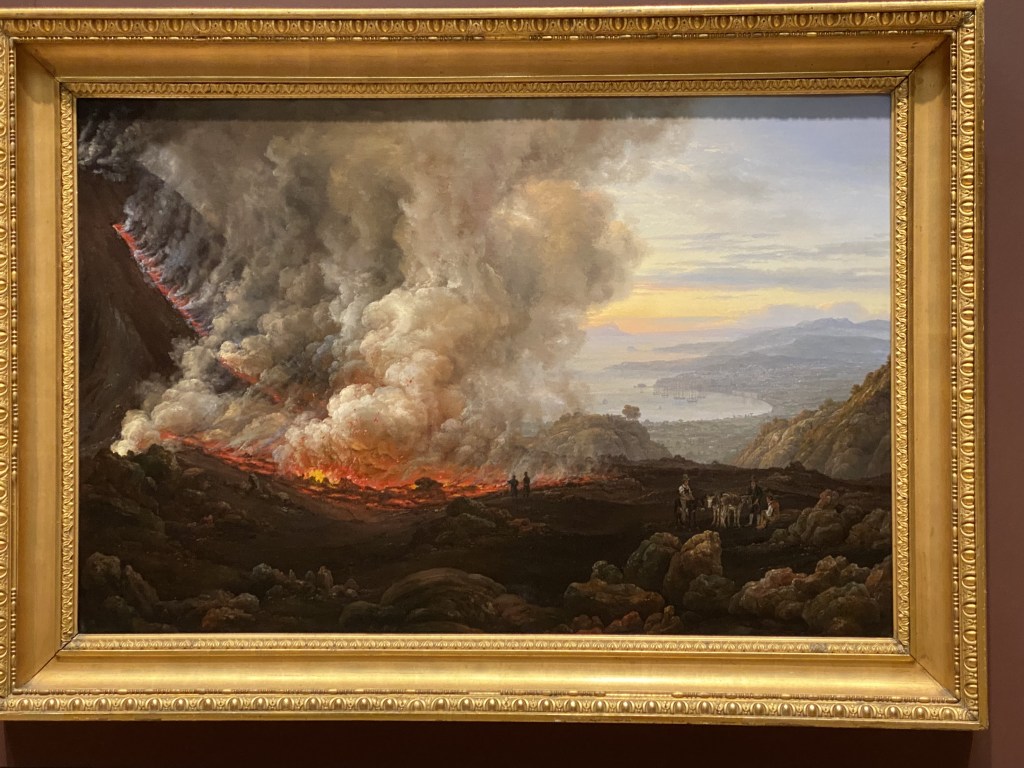
The next several galleries concern themselves with nature in many forms, including my least favorite, the landscape. I do try to like landscapes, I really do, and perhaps I am not educated enough to appreciate them, but they all seem like Thomas Kinkade Painter of Light schlock to me. He and every softball hotel hallway has done this to me. There were a few (out of dozens and dozens) that did appeal to me, which I will share as we come to them, but mostly I was meh about them. That being said, a return to nature was an understandable response to social and political upheaval, not to mention industrialization on a scale never before seen. I teach Romanticism and completely get Victor Frankenstein’s spiritual revival as he walks in the mountains. When he no longer desires to do this, the reader knows he is lost forever. I need to walk in the mountains. I love the mountains. Just not mountain paintings. This is starting to feel ranty…moving on. I loved The Weeders by Jules Breton, the way the twilight frames the faces of these workers. It reads as both pastoral and gritty, edging toward realism but still idealized. I enjoyed experiencing all those conflicting responses. I also appreciated this late Rousseau, An Early Summer Morning in the Forest of Fontainebleau. It reminded me a little of Van Gogh’s olive trees with the light touch and pastel palette. Camille Corot’s Hagar in the Wilderness is epic. Hagar and Ishmael are banished and yet blessed by the incoming angel.
Toward the end of the 19th century, many painters were venturing out of Europe into the Near East or North Africa. This style was called “Orientalist,” but in many cases could be more accurately called fetishist. There were some that made me squeamish like Bashi-Bazouk by Jean-Léon Gérôme. He returned from a trip to Turkey, then hired a model and dressed him in fancy Turkish silks, but titled the painting “headless” evoking poorly paid soldiers fighting for the Ottoman empire. But all fancy in silks – a strange rendering to me. But then, there is this one, a gorgeous and realistic rendering of An Egyptian Peasant Woman and Her Child by Léon Bonnat, which was painted in life while he was in Egypt for the opening of the Suez Canal.
There is a room of British nature painting, and this one on loan by a private collector, Ferdinand Lured by Ariel, by Sir John Everett Millais, inspired by a scene in The Tempest is a trip. Look at how Ariel and her imps are painted – lime green, utterly fanciful in contrast with the realistic natural world. This surprised me! There is also an entire gallery devoted to artists’ infatuation with Rome, which includes First Steps by Franz Ludwig Catel. Apparently babies taking first steps was a common subject for paintings after the French Revolution as it implied the hope of life going on. As it does.
The Met has a vast collection of paintings by Gustave Courbet, who seems like he was the kind of guy who would have loved social media. He declared himself to be “the proudest and most arrogant man in France,” and when his now famous Woman with a Parrot was acclaimed, he declared, “I told you a long time ago that I would give you a fist in the face. That bunch of scoundrels, they caught it!” Like and retweet! (Or are we threading now – I can’t keep up.) Meanwhile, a mere decade earlier, female artist Rosa Bonheur, was dressing as a man to escape notice as she snuck into the horse market to sketch twice a week. She was a celebrated and successful artist in her day, an open lesbian and successful self-promoter, two unseemly qualities for a 19th century woman to be sure. Her The Horse Fair, a massive canvas, was celebrated when it debuted at the Paris Salon in 1853. You can read more about her here.
One thing I do love in Courbet’s oeuvre are his female nudes. He chose to challenge the more typical, classical, idealized female nudes of the time like Alexandre Cabanel’s The Birth of Venus. Instead, Courbet painted women as they really are like the sumptuous The Woman in the Waves, armpit hair and all.
I took a spin through sculptures to end today’s visit. The large gallery features many Rodin sculptures: the large Adam and Eve and other parts of The Gates of Hell, one of my all time favorite sculptures. You can see the full Gates of Hell (not the original, obviously) at Cantor at Stanford. There is a small room devoted to Degas sculptures: ballerinas and horses. However, I was completely taken by his pastels. I knew he painted, but these pastels were really cool – very dynamic and bold in the brushstroke. Check out Woman Drying Her Foot.
There is a painting in the sculpture hall that I have passed by several times in the last few weeks, that I am drawn to, again and again, Flaming June by Victorian painter Frederic, Lord Leighton: “Her skin flushed by the summer sun, she is a personification of summer heat.” I will leave you with that, dear reader, as I venture out into this 90 degree NYC day.
 The Met Project