I was met at the members entrance today by half a dozen straggling climate activists who were protesting what they consider to be harsh indictments of their fellow activists who splashed paint on a case enclosing a Degas sculpture at the National Gallery in Washington DC in April. Apparently on June 24, a day I was not in the museum, a larger group of protesters surrounded a Degas ballerina to draw attention to the plight of those arrested in DC. Today, instead of being waved through security as usual, I was, along with everyone else, made to take my bag off my shoulder and allow security to remove and examine each item. Fortunately, I travel light, but the guard did take some time with my apartment keys, which has a mysterious blue fob attached. I guess he wanted to make sure it wasn’t a hidden knife that I could use to save the planet by defacing a painting or two. Don’t misunderstand: climate change is obviously the most important issue humanity faces today, but I’m not sure defacing art is the best way to go about dealing with it.
I scheduled Asian Art for today and tomorrow as summer weekends are bonkers here, and hardly anyone goes into those galleries. That is such a mistake! There were a good number of people there, the vast majority of them Chinese or Chinese-American. On the one hand, I felt pleased that this incredible collection of art and artifacts exists and that Chinese culture (often ignored by Americans) is on display; however, I also felt sad that so few non-Chinese people were enjoying it. I learned a lot and it was incredibly peaceful.
The first part of my journey into Chinese art was less than peaceful. The second floor balcony that is directly over the Great Hall is where the exhibits begin, case upon case of gorgeous porcelain and other ceramics from the 17th and 18th centuries. The roar from the hoards below was deafening. The balcony also seems to be a hot spot for professional engagement photos, at least two happening while I was there. Some porcelain that intrigued me include this Double-sided teapot with tree peonies. Evidence of the global trade happening in the world at the time is this Austrian Vase with coiling dragon, adapted from similar ones from the Fujian Province. I was besotted by this 15th century Dish with gardenias, which looks downright Italian to me. All of the flowers represent something, but gardenias in particular symbolize honor and happiness. A peculiar object of which I saw half a dozen examples, were porcelain neck pillows. They look incredibly uncomfortable but were quite popular with the ladies as they protected one’s elaborate hairdo. This one in the shape of a woman reclining is from the 12th-13th century, but they remained popular imports to Europe for hundreds more years.
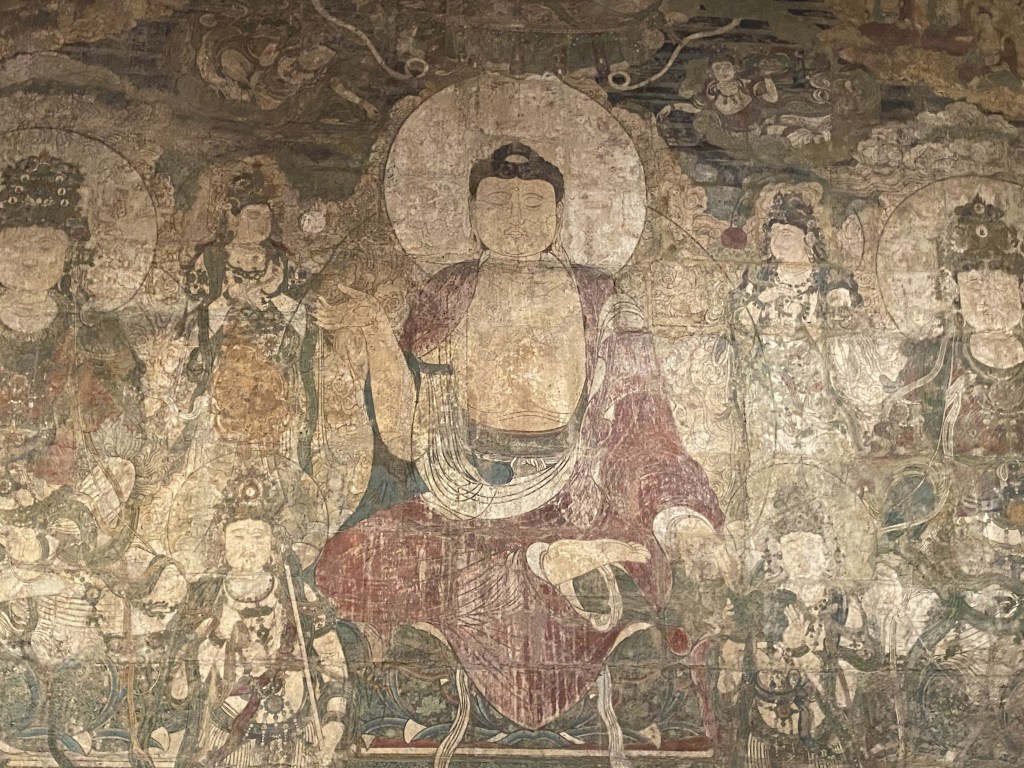
I left the din of the balcony for the tranquility of the Chinese art galleries. The first gallery is filled with buddha and bodhisattva statues. I learned that a bodhisattva is a person who is able to reach nirvana but delays doing so out of compassion in order to save suffering beings. This one is spectacular. There is also an enormous pigment painted clay and straw wall depicting the Buddha of Medicine from 1319. From there, there are ceramics and artifacts from the Neolithic and Bronze ages. This jade notched disc is from 2400-1900 B.C. I was amazed at the number of wine containers like this one from the Eastern Zhou dynasty from the 5th century B.C. and this Spouted wine vessel from the 12th century B.C. in bronze inlaid with turquoise. So lovely!
From there there is a small gallery devoted to the Year of the Rabbit. I was completely taken by this set of zodiac figures as well as this dapper rat from the late 17th century. The Han and Tang dynasties continued to produce beautiful ceramics. So far, that seems to be the art medium of choice. There is a lot of variation between eras and dynasties, but ceramics remain the form. This 6th century Tang dynasty “Inkstone” and cover in the shape of a turtle is striking, turtles being important symbols of longevity and endurance.
Right when I was up to here with porcelain and earthenware (just kidding, mostly), there are five galleries devoted to the art of Chinese painting framed around four ways in which an artist might learn their craft: family, mentors, manuals, and tradition. I took my time with these stunning scrolls and folios and books. It was difficult to decide which ones to link here as they are all terrific. Wang Meng from the 14th century learned to paint from his grandfather the landscape painter Zhao Mengfu. Here is his Red Cliffs and Green Valleys scroll. Zhao Mengfu and his wife Guan Daosheng are considered “the most famous power couple in the history of Chinese painting.” Respect. Their Orchid and rock; Bamboo scroll from the late 13th century demonstrates their virtuosity, but, alas, the image isn’t available, “returned to lender,” which makes no sense. These links aren’t going to do these scrolls justice – they are so delicately and meticulously painted. I read that Zhao Mengfu and Guan Daosheng became so proficient at imitating each other’s calligraphy style that they could flawlessly render the other’s at will. Lan Meng, following in the footsteps of his father Lan Ying, painted this hanging scroll, Boating amid Snowy Streams and Mountains.
There are several painting manuals on display, including the Mustard Seed Garden Manual of Painting, volumes 1-4, a woodblock-printed book published in 1611 as well as the Illustrated Seven-Character Poems of the Tang dynasty, one volume of Eight Kinds of Painting Manuals from 1621, also woodblock printed. Wordy titles; pretty books. The last painting gallery is devoted to paintings in the style of old masters such as Dal Xi’s Landscapes after old masters from the mid-19th century and Xie Zhiliu’s Lady Catching a Butterfly from 1944, the year my mother was born. It was satisfying seeing the painting both develop stylistically and remain in a traditional space over centuries.
In the center of all of this art lies a traditional Chinese garden. Rocks and water, the yin and yang. A tranquil spot and popular selfie spot.
To complete my day of Chinese art, I climbed up to the third floor, three galleries of Chinese decorative arts. I wasn’t entirely sure how these were to be distinguished from all of the vases a floor down, but there were several gems up here. The enameled porcelain was incredibly vivid in its saturated color. Look at this Vase with nine peaches, probably my favorite thing of the day. Although, the dish with peaches and bats gave me a giggle. Peaches and bats, an obvious pairing. Doh!
One can’t think of Chinese art and not think of jade. There was a lot of it! For instance, this ginormous jade basin, covered with swirling dragons. This one is dated from 1774 but is thought to have been inspired by one commissioned for Khubilai Khan in 1265. I loved this Vase in the shape of a heavenly rooster as well as this Double Gourd ornament. The one common theme for me today was symbolism. Nature in all its forms: animal, vegetable, and mineral, exists to impart meaning. Jade is well known as significant in Chinese culture, but again, symbolism is key. Take jade, physically known to be “rich in color, translucence, sensuous feel, and extreme resistance to external forces […] The Chinese compare these physical qualities to aspects of moral character: the smooth texture to humanity, the dense structure to intellect, and the translucent to honesty to name only a few. The slow and laborious working of jade is also likened to the process of perfecting the human mind; only through long and persistent effort can true character and integrity be developed.”
 The Met Project